
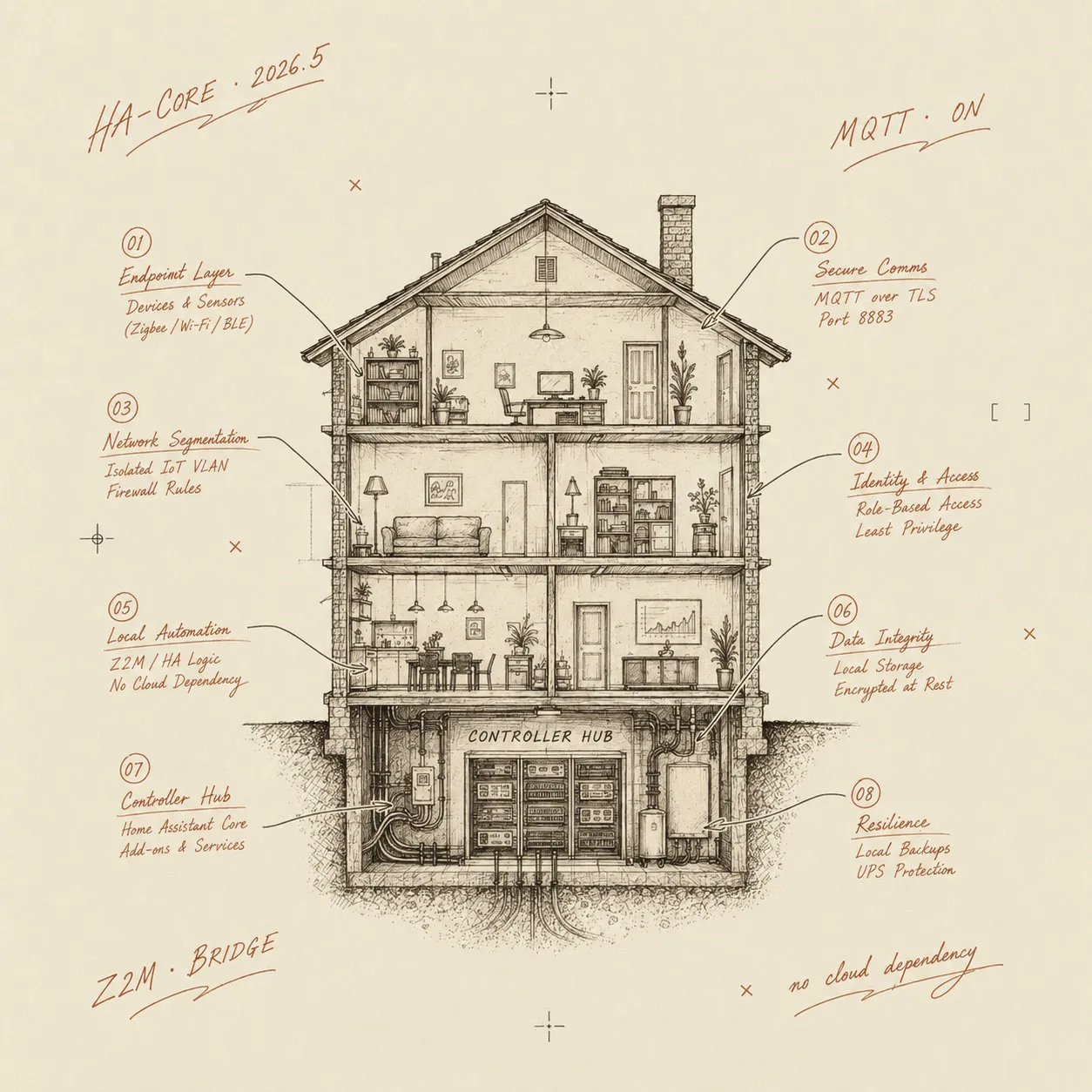
What it is
We deploy Home Assistant as an open automation platform — for residential spaces, offices, and industrial sites. Special focus: integration of legacy devices — reading signals from old controllers, adding brains to equipment that never had any, bridging protocols from the 90s and 2000s.
What’s included
- Home Assistant architecture and rollout: local install (no cloud dependency), integration with existing networks, auth, redundancy.
- Legacy device integration: Modbus, KNX, RS-485, MQTT, custom serial protocols. If the device has even one port, we’ll figure out how to read it.
- Bridges to closed ecosystems: wrappers around devices from vendors that don’t expose local APIs. Example: reverse engineering via traffic capture, emulating cloud endpoints locally.
- Automations and scenarios: from basics (lighting, climate, security) to industrial (monitoring and reacting to events on a production line).
- End-user UI: Home Assistant dashboards tailored to specific scenarios, mobile access, voice control.
When you need this
- An older building with mixed equipment across vendors and decades: HVAC on one protocol, ventilation on another, lighting on a third — and you want one control surface.
- You have industrial controllers or measurement instruments with no formal API but a physical interface.
- You need automation without cloud dependency — data and logic must stay on-site.
Track record
We run our own Home Assistant deployments in continuous production, where we work out complex integrations and verify long-running stability before rolling them into client infrastructure.