
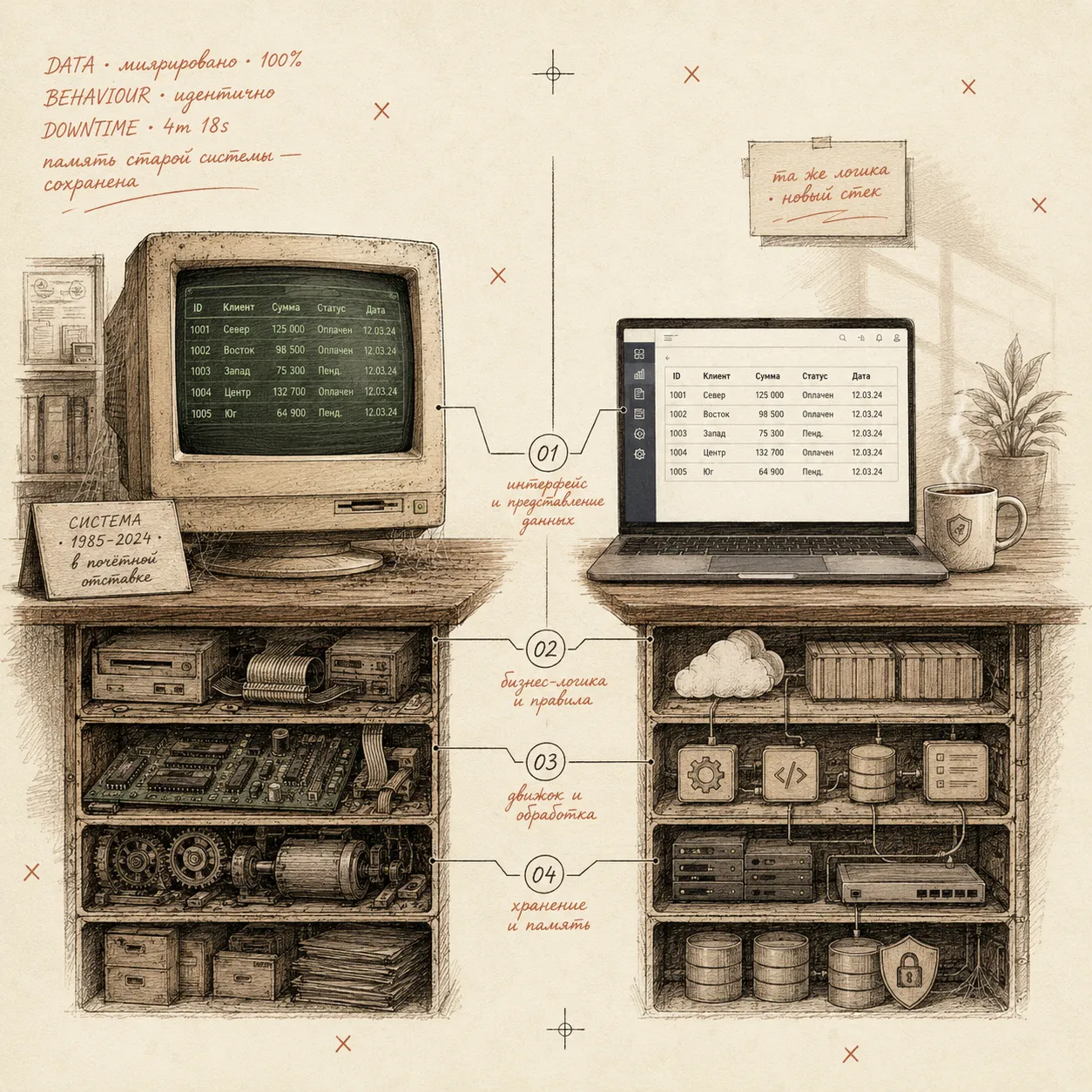
What it is
Over the years, business-critical software finds itself on a platform that no longer exists. The vendor closed shop or stopped supporting the product. The source is still around, but it was written for an old compiler, kernel, or language standard — and simply will not build on a current operating system.
Switching the business process to a “modern alternative” is a long and risky exercise, especially when the original tool covers a specialised task with no off-the-shelf replacement. Most of the time, restoring the existing program to working order on the current platform is enough — without changing how people use it.
We rewrite outdated components against modern APIs while preserving behaviour and interfaces. The program keeps working the way it always did — only now on a current operating system, in a current build toolchain, and free of dependencies whose support window has expired.
What’s included
- Drivers and kernel modules — migrating off deprecated APIs to current ones. Supports modern Linux kernel versions without losing device functionality.
- Userspace applications and libraries — alignment with modern language standards, resolving incompatibilities with current compilers.
- Modern build system — moving off legacy Makefiles or scripts to current tooling, support for the target OS package manager, packaging for easy distribution.
- Documentation and handover — we record what changed and why. The next OS upgrade isn’t a fresh archaeology project.
- Verification pass — we check the updated version behaves the same way as the original before handing it back to production.
When you need this
- A business-critical application stopped building after an OS or kernel upgrade.
- The vendor is gone or no longer maintains the software, but the source is in your hands.
- No off-the-shelf product covers the same niche — a full rewrite isn’t economically justifiable.
- The software still works but requires outdated components for which security updates are no longer issued.
- Your environment has accumulated old utilities that can’t be removed but shouldn’t be left unattended either.
Experience
We work with both userspace applications and system-level components — drivers, Linux kernel modules, low-level libraries. We have a track record of bringing 10–15-year-old code, originally written for older kernels, back to fully working order on current distributions.
Approach
We don’t rewrite what already works. The intervention is minimal, focused on compatibility with the current platform. Every change is documented line-by-line, so the client can see exactly what was done and the next maintainer doesn’t start from scratch.